Process
For the third assignment of the building block, I focused on interoperability. In Assignment 2.1, I designed a modular dock system with magnetic alignment and recessed pin contacts. In Assignment 2.2, I built a LEGO prototype to test the physical interaction (whether modules were easy to attach, remove, and reorder). For this assignment, I needed to ask how my system could connect not only to itself, but also to other materials and construction methods (also looking at the suggestions and feedback I got in the first assignment for Session 3).
Inspired by the Free Universal Construction Kit, I tried to design an interface piece that acts as a bridge between systems. Rather than making a module that only docks to other modules, I developed a module adapter that keeps my own connection language on one side and translates it into a more open mounting surface on the other. The adapter includes multiple attachment options, such as screw holes, strap slots, and an adhesive area, so it can connect to cardboard, wood, plastic, fabric, and custom supports. The goal is not just modularity inside the system, but interoperability outside it. The first iterations focused on modularity within the system; this iteration focused on interoperability beyond the system.
Design
To arrive at a final direction, I explored the concept from specific --> semi-specific --> most universal.
Option A - Brick Bridge (Figure 1)
"Translate the dock system into a stud-based building language."
This was the most direct reference to the Free Universal Construction Kit. The idea here was to make an adapter that would connect my dock system to a brick-based construction system, such as LEGO. In this case two versions, one with a 2x2 connector and one with a 2x4 connector. One side would keep my own dock connector, while the other side would become a stud-based surface.
What makes this option interesting is that it clearly shows interoperability between two recognisable systems. It would also be visually easy to understand in sketches and prototypes: you immediately see that one connection language is being translated into another. At the same time, I felt this option stayed a bit too close to my previous prototype, since I had already used LEGO as the material for the LoFi version. Because of that, it felt more like a continuation of the prototype material than a broader step towards open-ended interoperability.
Option B - Panel Clip Adapter (Figure 2)
"Translate the dock system into a clip connection for thin sheet materials."
The second option was more focused on spatial prototyping and construction with flat materials. In this design, the adapter keeps my dock-side connector on one end, while the other end becomes a clip or slot that can grip materials such as cardboard, foam board, acrylic, or thin plywood.
This option seemed useful because many quick prototypes and desk structures are made from flat sheet material. A clip-based solution could allow modules to be attached to dividers, mock-up walls, lightweight stands, or other temporary constructions. It also introduced a more architectural use case for the system, which made the project feel less like a fixed consumer product and more like something users could incorporate into their own setups (like I discussed in earlier assignments).
The limitation of this option is that it only works well within a certain material thickness (even though it can move a bit). That means it is more flexible than a brick adapter, but still not fully universal. It solves interoperability for one category of materials, rather than creating a broader bridge.
Option C - Open Mount Adapter (Figure 3)
"Translate the dock system into a universal attachment surface for multiple materials."
The third option was the most open and the one I eventually chose. Like the other versions, it keeps my own dock connection on one side. The difference is that the opposite side no longer targets one specific material system. Instead, it becomes a general mounting face with multiple ways to attach it.
In this version, I imagined:
- screw holes for more permanent mounting to wood, acrylic, panels, or custom supports,
- strap slots for zip ties or velcro, allowing it to be attached to fabric, cables, poles, desk frames, or temporary structures,
- and an adhesive area for quick attachment to cardboard, foam, plastic, or other lightweight surfaces. But this can also be replaced by Velcro.
This option felt strongest because it provides the widest interoperability with the fewest limitations. Rather than adapting my system to one other "connection method/language," it opens the system to several material languages at once. That makes it much more relevant to the critique/feedback that my earlier concept was modular but not yet very tinkerable. The Open Mount Adapter not only say "this module belongs in this system,” but it also says “this module can be repurposed in different contexts."
Evaluation
A useful way to evaluate interoperability is to ask what new structures become possible once the adapter exists. With only the original dock modules, the system mainly supports one type of structure: a horizontal chain of modules connected to the base hub. The adapter expands that considerably.
With the Brick Bridge, the dock system could become part of brick-based structures, for example, a small desk stand, a support frame, or a LEGO-based section. With the Panel Clip Adapter, the blocks could be attached to cardboard, foam board, acrylic sheets, or temporary walls, which would make more architectural or exhibition-like setups possible. With the Open Mount Adapter, the possible structures become broader still: the system could be strapped to a desk leg, screwed onto a wooden support, fixed under a table, attached to a monitor arm, or mounted onto a custom prototype surface.
So the main difference between the three options is not only what they connect to, but also what kinds of structures they enable:
- Brick Bridge: Playful modular structures inside another building system
- Panel Clip Adapter: Lightweight spatial prototypes and sheet-based constructions
- Open Mount Adapter: The widest range of mounted, distributed, or repurposed setups
This comparison made me choose Option C more confidently, because it supports the greatest variety of combinations and therefore the most open-ended structures.
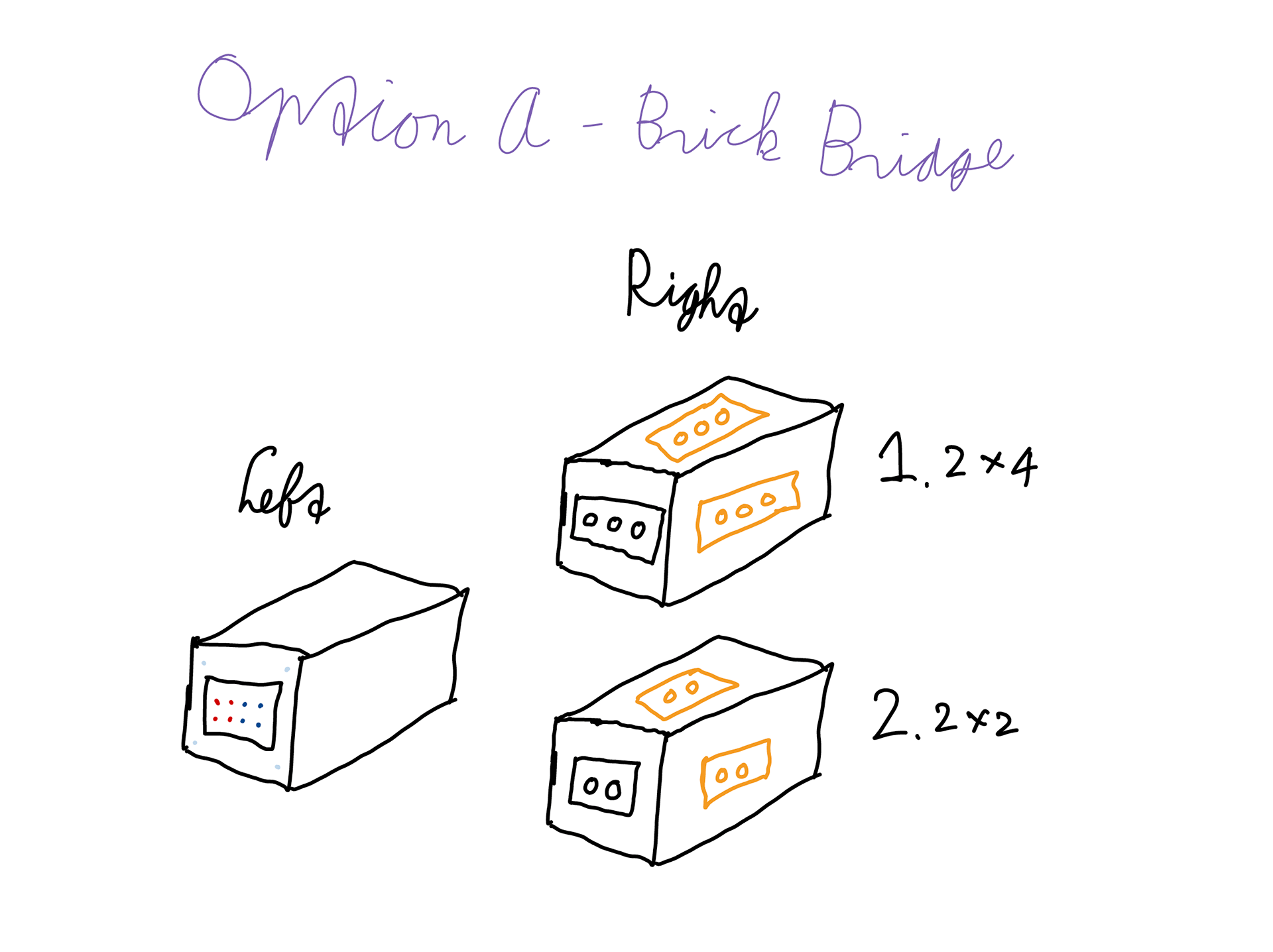
Figure 1. Option A, Brick Bridge.
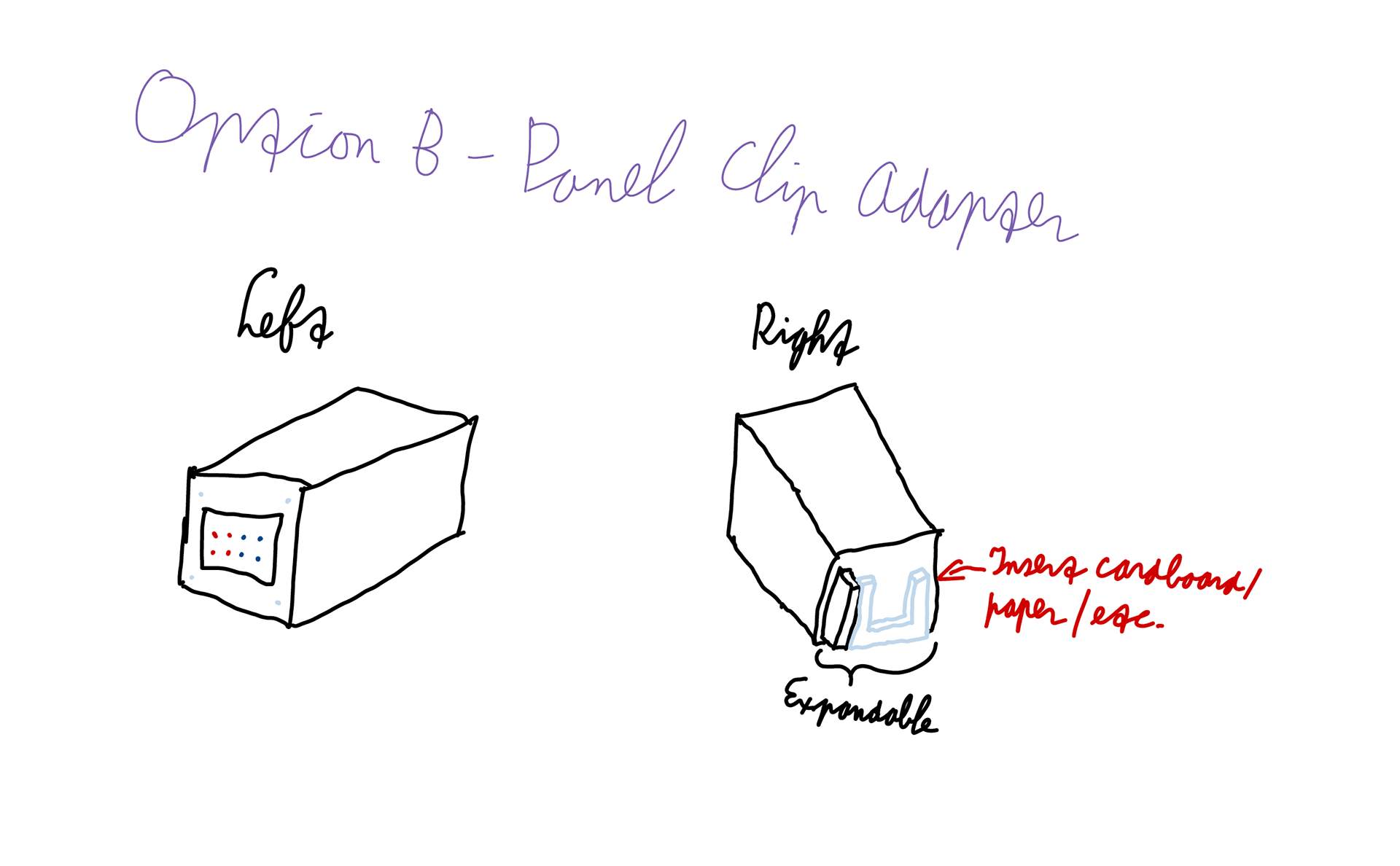
Figure 2. Option B, Panel Clip Adapter.
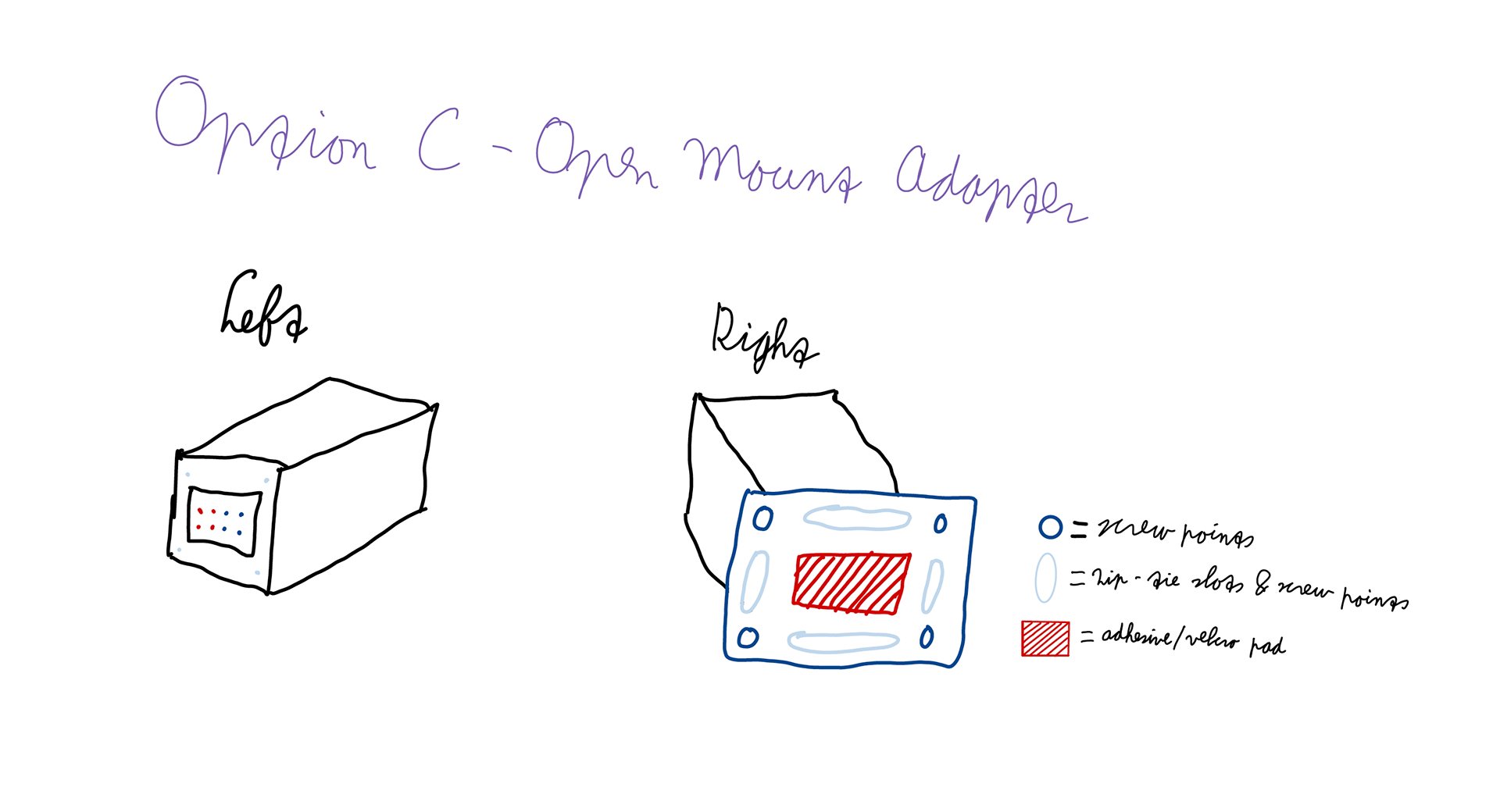
Figure 3. Option C, Open Mount Adapter.