Group work and Collaborators
This poster and movie were developed during the final (eighth and ninth) Social Robot Design sessions as part of Group 1. The aim of these sessions was to turn the results of our tools-in-action work into a clear visual poster and a short demonstration movie. The focus was to show the Pet Anxiety Toolkit in action, explain the case quickly, demonstrate the toolkit with the robot and props, and reflect on what worked and what still needs improvement.
Collaborators:
Maurits Dijkman, Bianca Filip, Ewoud Janus, Emilia Pavel, and Gijs Vis.
My contribution:
My contribution was both practical and reflective. I acted in the final movie, helped record video material, and gave feedback during the editing process. I also helped connect the poster and movie to the design reasoning behind the Pet Anxiety Toolkit: why testing directly with anxious pets is risky, how the toolkit helps reveal robot–dog failure points, and what the observed failures mean for the next design iteration. In the reflection, I focused especially on the need for clearer instructions, more durable materials, a better attachment system, safer treat placement, and a more intuitive control system.
1. Poster
The poster presents the Pet Anxiety Toolkit, or PAT, as a scenario design toolkit for exploring how robots can help anxious pets that are left alone at home. The poster introduces the robot, the context, the tool, and the result in a visual way.
Figure 1 shows the final group poster. The poster makes the case and tool identifiable quickly by introducing Allan as a robot that keeps home-alone dogs company and PAT as a scenario design toolkit for exploring how robots can help anxious pets left alone at home. The poster also shows the toolkit components: scenario cards, toolkit manual, side panels, props, a treat dispenser, a ball thrower, and the Allan robot.
The poster follows a clear problem-tool-result structure. First, it explains the problem: anxious dogs left alone may whine, cry, or become aggressive. Then it introduces PAT as a tool for acting out scenarios before real animal testing. Finally, it states the result clearly: PAT exposes robot-dog failure points in minutes, through acting, with no real animal at risk.
This directly supports the poster rubric because the reader can understand the robot, the context, and the tool without reading a long explanation. The poster quickly communicates that the project is about a pet companion robot, anxious home-alone dogs, and a card-based toolkit for testing robot-dog interactions.
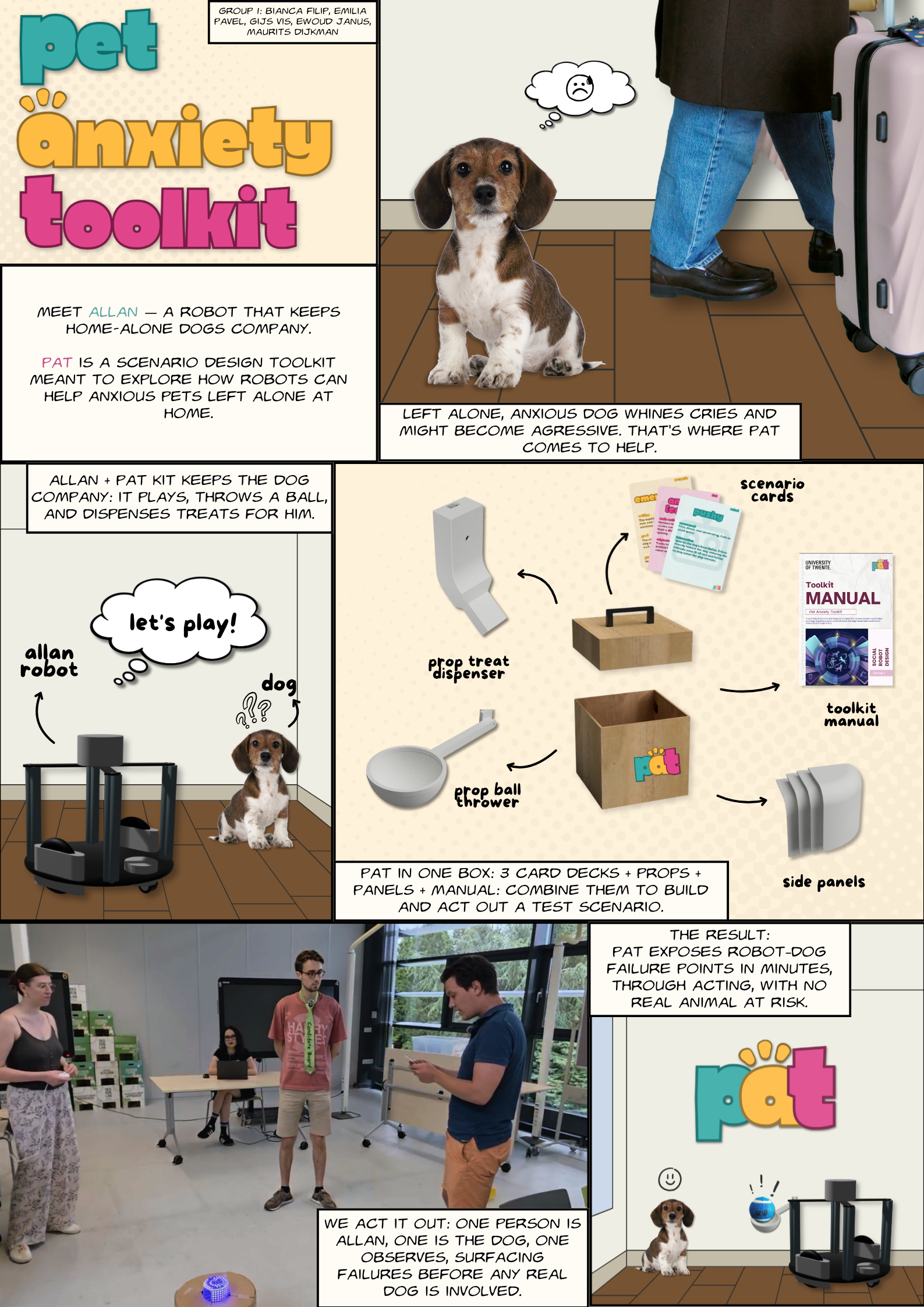
Figure 1. Poster introducing the Pet Anxiety Toolkit, showing the toolkit concept, its scenario cards, props, manual, and roleplay method for identifying robot-dog interaction issues before testing with real animals.
2. Poster tool structure
Figure 1 visualises the structure of the toolkit instead of only describing it in text. The poster presents PAT as a physical toolkit in one box, containing three card decks, props, side panels, a manual, and the robot. This makes the tool tangible and understandable at a poster distance.
The tool structure is based on combining different cards and props to create a test scenario. One person acts as (controls) Allan, one person acts as the dog, and one person observes. This role division is shown on the poster and is also demonstrated in Video 1. The purpose is to surface failures before involving a real dog.
This is important because the assignment asked us to show the things we did rather than only describe them. Figure 1 shows the toolkit as a physical system: cards, props, a manual, a robot, and a result.
3. Poster evidence of application
Figure 1 also shows evidence that the tool was applied. It does not present PAT only as a theoretical method, but as a physical design toolkit connected to the robot and deployment context. The poster includes the robot, dog, props, cards, manual, side panels, treat dispenser, and ball thrower.
This evidence matters because the project is about testing robot-dog interaction before real animal testing. The poster shows that the tool is meant to be acted out. It is not just a set of instructions; it is a toolkit for staging and observing robot-dog scenarios.
The result is also made explicit on the poster: PAT exposes failure points quickly, through acting, without putting a real animal at risk. This makes the design outcome visible rather than hidden in long text.
4. Movie
The movie demonstrates the Pet Anxiety Toolkit in use. It not only describes the tool; it shows how the tool can be used to create and test scenarios.
Video 1 presents the challenge, introduces the toolkit, demonstrates scenario testing, and reflects on what failed and what changed. The video begins by explaining why designing robots for pets is difficult: animals have different personalities, and a robot that de-stresses one pet might stress another. It also explains why direct live testing is risky: an anxious pet cannot explain what went wrong, and if the interaction harms the pet, the consequences may last.
The movie frames the challenge before introducing the tool. The viewer understands the design problem early: testing robot behaviour directly with anxious pets is ethically and practically risky, so the group needed a safe way to catch interaction problems before live animal testing.
I also contributed to the movie production by acting as the dog in the video, helping record material, and giving feedback during the editing process. This helped make the movie clearer as a demonstration rather than only a verbal explanation.
5. Movie demonstration of the tool
Video 1 demonstrates the toolkit through acted test scenarios. The group introduces three types of cards: one for how the robot should act, one for how the dog should act, and one for the actual scenario. This shows the tool's protocol clearly.
In the first demonstrated scenario, the dog is calm and obedient. The dog approaches the robot gently and waits patiently. The robot moves smoothly, predictably, and without special errors. The scenario should take place in a tiled kitchen next to the dog's usual feeding spot, but we used the Design Lab for ease-of-use. The goal is for the robot to feed the dog using a food dispenser and place food into the food bowl.
This first scenario demonstrates the "happy path." It shows how the cards can be combined into a concrete test situation with a robot role, a dog role, a setting, a goal, and a prop.
In the second demonstrated scenario, the robot behaves very differently. It is fast, direct, pushy, and ignores the dog's social boundaries by entering within about half a metre of its space. The dog is destructive, mouthy, and tries to paw or bite the moving robot. The scenario is "getting familiar," where the dog meets the robot for the first time in a home living room.
This second scenario demonstrates why the toolkit is useful. A scenario like "getting familiar" sounds safe, but when it is combined with a pushy robot card and a destructive dog card, it becomes a risky interaction. Video 1 shows how the toolkit can reveal this before a real dog is involved.
6. Failure and unexpected findings
Video 1 includes several failures and unexpected findings. This is important because the assignment asks for more than a polished final product. It also asks us to show what was learned through testing.
The first issue was that people found it confusing how to start using the toolkit. This led to the creation of the manual, so people could use the toolkit independently without needing the group's verbal instructions.
The second issue was that the first version of the cards was not clear enough. The group redesigned the cards by defining the three different roles through colour and simplifying the text so the cards would be easier to use.
The third issue was physical durability. The robot's body was made from cardboard and was therefore not durable enough. concluded that a future iteration would need a harder shell.
The fourth issue was the attachment system. Hot glue was too temporary and not repeatable enough. A better mounting system is needed so props such as the treat dispenser can be attached reliably.
The fifth issue was treat placement. In the first iteration, treats dropped too close to the robot. This could pull the dog into the robot's space, which is not ideal for an anxious pet. We therefore extended the spout in the second version so that treats are dropped further away from the robot.
The sixth issue was control. The Wii control system was unintuitive for first-time users. A better control system is needed so that someone who has never used the robot can operate it without long practice.
7. Evaluation of the Design Outcome
The design outcome improved because the project moved from a general idea of a pet companion robot to a concrete testing setup. Before the toolkit, the case could be described as "a robot that keeps anxious dogs company." After the toolkit, the design became more specific: Allan must be tested through scenarios where dog temperament, robot state, props, and environment can vary.
The toolkit also changed the design priorities. The goal is not simply to make the robot more interactive. The goal is to identify where interaction can become unsafe, confusing, pushy, or stressful. Video 1 shows this clearly by comparing a smooth routine feeding scenario with a more problematic "getting familiar" scenario involving a pushy robot and destructive dog behaviour.
The outcome is therefore better grounded than before. It connects the robot's behaviour, embodiment, and props to realistic interaction risks. It also shows that design improvement can come from failure: unclear cards led to clearer cards, unclear instructions led to a manual, poor treat placement led to an extended spout, and control problems led to the need for a simpler operator interface.
8. Evaluation of the Tool Quality
As a tool, PAT works because it is specific, tangible, and easy to demonstrate. It is not a generic brainstorming method. It is designed specifically for robot-dog interaction around anxious pets at home.
The strongest quality of the tool is that it makes failure visible before animal testing. Figure 1 summarises this result clearly: PAT exposes robot-dog failure points in minutes, through acting, with no real animal at risk. This is the main value of the tool.
The tool is also usable because it has a clear structure: cards, roles, props, and a manual. However, testing showed that the tool was not immediately self-explanatory in the first version. The manual and redesigned cards were therefore necessary improvements.
The tool is partly generalisable. It could be adapted to other pet-robot projects by changing the cards and props. However, it should not be used unchanged for other animals or users, because different species and user groups have different behaviours, risks, and welfare needs.
I would recommend the tool for early-stage pet-robot design, especially before live testing. It is useful for finding obvious failure points, but it does not replace real animal-centred evaluation with welfare criteria.
9. Individual reflection
My main learning from the poster and movie assignment is that communication is part of the design tool. A tool can be useful, but if people do not understand quickly what it is, how to start, or what result it produces, then it is not yet a strong design tool.
The poster helped make the project understandable at a glance. It shows the robot, the dog, the toolkit components, and the result. The movie helped show the tool in action and made the failures more convincing than a written explanation would.
My own contribution was practical and creative. I acted in the video, helped record the footage, and gave feedback during the editing process. This meant I was involved not only in the content of the toolkit, but also in how the group communicated the tool to others. Acting in the video also helped me understand the tool differently, because it made the scenario feel more concrete than when it was only described on cards.
If I could change one thing, I would make the video include a clearer final comparison between version 1 and version 2 of the toolkit. The movie already explains the changes, but a side-by-side visual comparison would make the iteration even easier to understand. I would also add a short on-screen checklist for the two evaluation axes: 'Did the robot design improve?' and 'Does the tool work as a tool?'
10. Conclusion
The poster and movie show the final group result clearly. The case is a pet companion robot for anxious home-alone dogs. The tool is the Pet Anxiety Toolkit, a physical card-and-prop toolkit for acting out robot–dog scenarios. The result is that the toolkit can reveal failure points quickly, before any real animal is placed at risk.
The most important insight is that the robot should not be designed only for successful interaction. It must also be designed for uncertainty, refusal, destructive behaviour, poor timing, unclear control, and technical failure. PAT gives the team a practical way to rehearse these problems before they become real.